

HiGS takes input as thermal images of the same scene at different temperature conditions, infers thermal transport properties, and separate the reflection from the total radiation observed from the camera. It further enables re-heating: re-position the radiator and change its temperature and emissivity, and predict the reflections under the new heating condition.
Overview: hemicube + radiosity + radiance cache
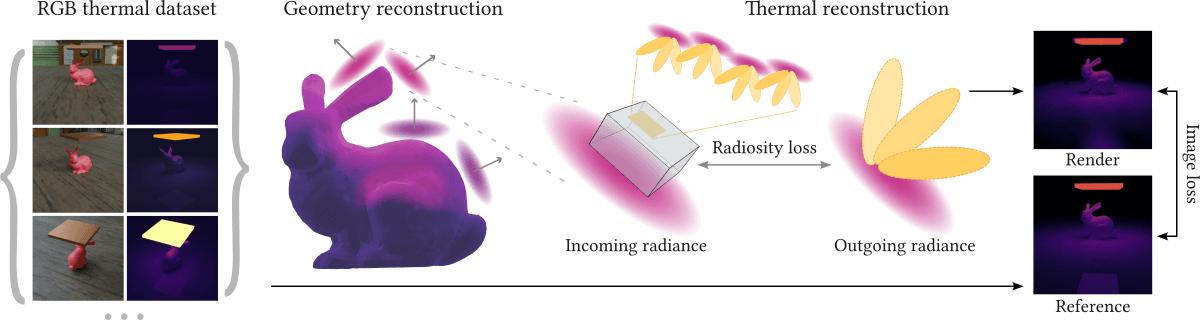
HiGS first reconstructs a set of 2D Gaussian primitives that represent the geometry of the scene. Then, we compute the incoming radiance at each Gaussian primitive by rasterizing other primitives using hemicubes, and represent the outgoing radiance using Spherical Gaussian (SG) basis. The outgoing radiance and thermal properties are supervised by the image loss between the reference images and renderings, and a radiosity loss that promotes the separation of reflections.
Results

We validate our method on synthetic dataset. We show reference/rendered total radiation and reflection.

Our method is also tested on real capture data. We move the heated teapot and predict its reflection in the new positions.
Acknowledgments
Bharath Seshadri’s position is funded by the Albert Lück Stiftung via the ETH Zürich Foundation for the project “Extended Reality for Inspection, Assembly, Operations for net-zero carbon infrastructure”. The authors thank the anonymous reviewers for their valuable feedback; Dominik Stoll for his help with the figures; Jeremy Chew for many insightful discussions; Stanford University Computer Graphics Laboratory for the Stanford Bunny model.