

Pipeline
WinDiNet repurposes a 2-billion-parameter video diffusion transformer as a fast, differentiable surrogate for computational fluid dynamics (CFD) simulations of urban wind patterns. Fine-tuned on 10,000 CFD simulations across procedurally generated building layouts, it generates complete 112-frame wind field rollouts in under one second — over 2,000x faster than the ground truth CFD solver.
- Physics-informed VAE decoder: Fine-tuned with incompressibility and wall boundary losses for physically consistent velocity field reconstruction
- Scalar conditioning: Fourier-feature-encoded inlet speed and domain size replace text prompts, enabling precise physical parametrisation
- Differentiable end-to-end: Enables gradient-based inverse design of urban building layouts for pedestrian wind comfort
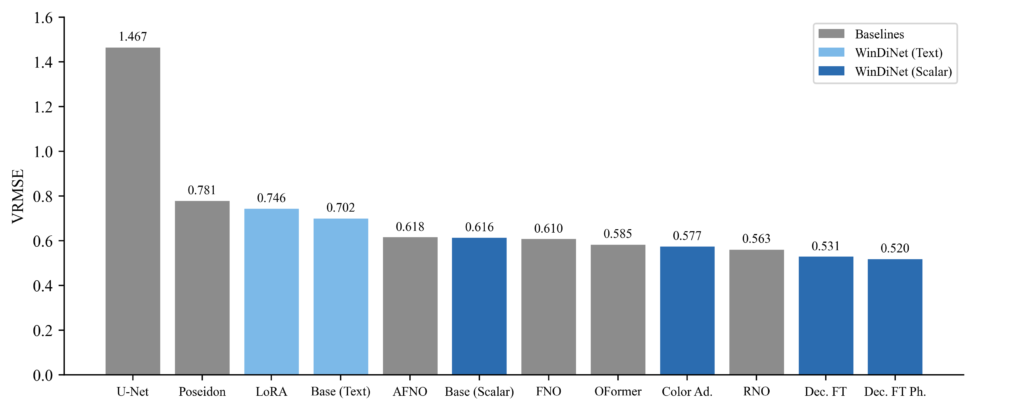
- State-of-the-art accuracy: Outperforms specialised neural operators (FNO, OFormer, Poseidon, U-Net) on vRMSE, spectral divergence, and Wasserstein distance

VAE Adaptation
The pretrained LTX-Video VAE introduces reconstruction artifacts that degrade physical fidelity. We compare the base VAE against two decoder fine-tuning strategies: a pure MSE loss and a physics-informed loss that additionally penalizes divergence and momentum residuals. The physics-informed variant recovers fine-scale flow structures most faithfully.

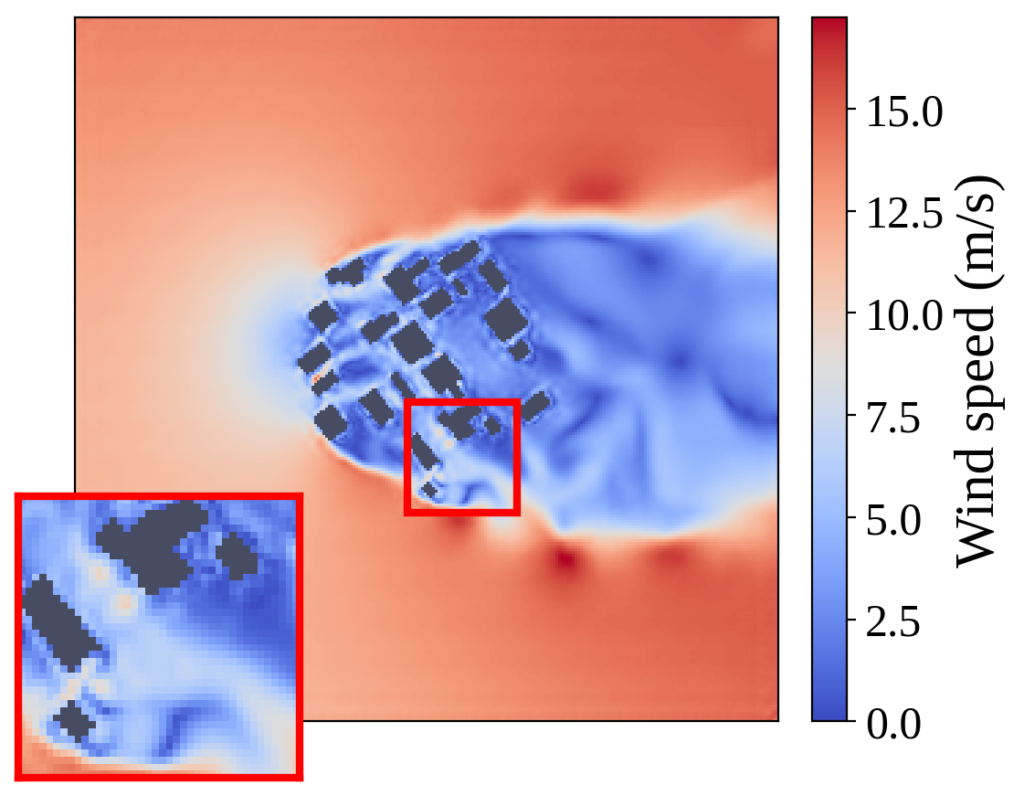

(VRMSE: 0.087)
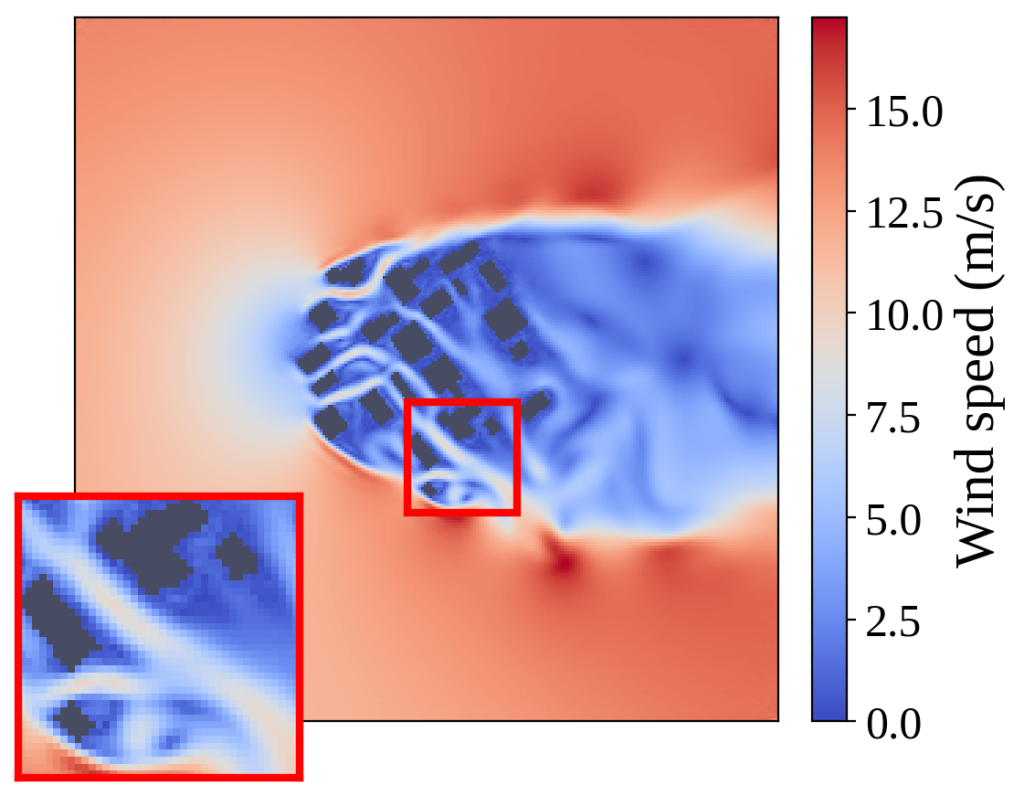
VRMSE: 0.070
Benchmarking
We compare WinDiNet against purpose-built neural PDE solvers (OFormer, RNO, FNO, AFNO, U-Net, Poseidon) as well as our own ablations: LoRA fine-tuning and text-based conditioning. The best variant, Dec. FT Physics (fine-tuned decoder with physics-informed losses, scalar conditioning), outperforms all baselines on pointwise metrics while generating all 112 frames in a single forward pass in under a second.
Inference
At inference, the user provides a building footprint, an inlet speed, and a domain size. WinDiNet generates a full 112-frame velocity rollout in under a second.
Inverse Optimization
Since WinDiNet is end-to-end differentiable, it can serve as a physics simulator for gradient-based inverse optimization of building layouts. Building positions are iteratively updated to minimize a comfort loss that penalizes dangerous gusts, speeds outside the desired comfort range, and stagnant zones in a downstream objective region.



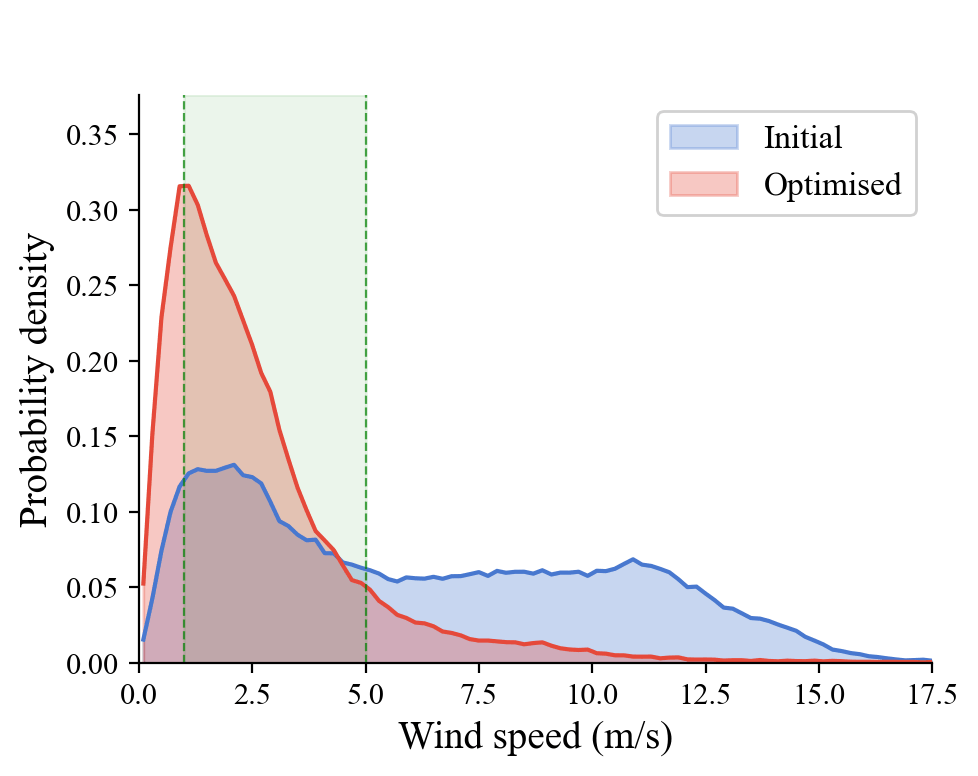
Note that multi-inlet optimizations are possible. This allows the creation of settings in which winds from different directions, with varying inlet velocities, are treated differently during optimization. Refer to the paper for an example that sets the target band for western winds to 1m/s-3m/s, whereas winds from the north should fall into the 3m/s-5m/s band.
Further extensions include reparametrizing the buildings and allowing minor “morphing” of their shapes to improve wind flow. Examples are shown in the paper.
Acknowledgments
We thank Cornelia Kalender for her guidance on selecting appropriate evaluation metrics for the CFDcomparisons. We thank Kai Marti for providing the real-world building footprints used in the generalization experiments. We thank Spencer Folk for providing access to the codebase for the fluid solver used to generate the dataset. This work was supported by a grant from the Swiss AI Initiative, operated by the Swiss National AI Institute (co-founded by ETH Zurich and EPFL). We gratefully acknowledge the Swiss National Supercomputing Centre (CSCS) for providing compute resources on the Alps infrastructure.